
Step 3: Identify implementation strategy or strategies
What is an implementation strategy?
Implementation science is fundamentally concerned with identifying effective strategies for implementing evidence-based interventions. Therefore, it is critical to understand the difference in what is meant by implementation strategies and evidence based interventions.
Evidence based interventions are the what that is being implemented. Implementation strategies are how we seek to get evidence based interventions into normal practice in clinical or community settings. This distinction between “what” and “how” is useful for distinguishing implementation strategies from evidence based interventions.
Implementation strategies are the actions taken to enhance adoption, implementation, and sustainability of evidence based interventions.
Evidence based interventions are programs, practices, principles, procedures, products, pills, or policies that have been demonstrated to improve health behaviors, health outcomes, or health-related environments.
For an in-depth explanation of implementation strategies, read Kirchner and colleagues' excellent introduction in Psychiatry Research (2019).
Grouping implementation strategies
Implementation strategies can target determinants at any level of the social ecological model, and can be used individually or in combination with other strategies.
Implementation strategies can be a single strategy (e.g. training), or a bundle of strategies to address multiple implementation barriers (e.g. the use of both reminders and role revisions), or blended strategies that are multiple strategies packaged and branded for use (e.g. the Leadership and Organizational Change Intervention). The decision to use one or more implementation strategies should be tied to specific target determinants and the part of the implementation ecosystem they exist in, as well as the available evidence that the strategy or strategies will be effective for this purpose.
In 2015, the Expert Recommendations for Implementing Change (ERIC) project published a refined compilation of implementation strategy terms and definitions compiled by systematically gathering input from stakeholders across implementation science and clinical practice. The resulting table of 73 implementation strategies can be found here or in the original Open Access (✪) article in the journal Implementation Science.
Waltz and colleagues then used concept mapping to characterize relationships among the 73 implementation strategies and assess their feasibility and importance, resulting in nine clusters of implementation strategies. While not exhaustive, below we provide examples of the different strategies found in each of the nine distinct clusters.
The IS Research Pathway
Find Examples

Browse our Library of UW community co-authored publications to see examples of research on a selection of implementation strategies.
Open Access articles will be marked with ✪
Please note some journals will require subscriptions to access a linked article.
Use Evaluative/Iterative Strategies
-
Assess for readiness, identify barriers/facilitators
-
Audit and provide feedback
-
Purposefully re-examine the implementation
Assess for readiness and identify barriers and facilitators
- From Evidence-Based Implementation Guides to Meaningful Action: Public Health Practitioners Use Readiness Assessments to Build Bridges to Successful Community Prevention Implementation
- ✪ Mapping the organizational readiness to change assessment to the Consolidated Framework for Implementation Research
- ✪ Development of a Field Guide for Assessing Readiness to Implement Evidence-Based Cancer Screening Interventions in Primary Care Clinics
- ✪ Readiness as a precursor of early implementation outcomes: an exploratory study in specialty clinics
Audit and provide feedback
- Reinvigorating stagnant science: implementation laboratories and a meta-laboratory to efficiently advance the science of audit and feedback
- Sustainability, spread, and scale in trials using audit and feedback: a theory-informed, secondary analysis of a systematic review
- Identifying behaviour change techniques in 287 randomized controlled trials of audit and feedback interventions targeting practice change among healthcare professionals
- A step toward understanding the mechanism of action of audit and feedback: a qualitative study of implementation strategies
- ✪ Audit and feedback: effects on professional practice and patient outcomes (Cochrane Review)
Purposefully re-examine the implementation
- ✪ Implementation outcomes of the integrated district evidence to action (IDEAs) program to reduce neonatal mortality in central Mozambique: an application of the RE-AIM evaluation framework
- ✪ Assessing drivers of implementing “Scaling-up the Systems Analysis and Improvement Approach” for Prevention of Mother-to-Child HIV Transmission in Mozambique (SAIA-SCALE) over implementation waves
- ✪ Implementation Evaluation of a Complex Intervention to Improve Timeliness of Care for Veterans with Transient Ischemic Attack
- ✪ Qualitative evaluation of the Systems Analysis and Improvement Approach as a strategy to increase HIV testing in family planning clinics using the Consolidated Framework for Implementation Research and the Implementation Outcomes Framework
Engage Consumers
-
Increase demand
-
Use mass media
-
Involve patients/consumers, family members
Increase demand
- ✪ “Now is the time for institutions to be investing in growing exercise programs as part of standard of care”: a multiple case study examining the implementation of exercise oncology interventions
- ✪ Using audience segmentation to identify implementation strategies to improve PrEP uptake among at-risk cisgender women: a mixed-methods study protocol
Use mass media
- Disseminating implementation science: Describing the impact of animations shared via social media
- ✪ HIV self-testing among key populations: an implementation science approach to evaluating self-testing
- ✪ Extending analytic methods for economic evaluation in implementation science
Involve patients/consumers and/or family members
- ✪ Acceptability and Feasibility of Pharmacy-Based Delivery of Pre-Exposure Prophylaxis in Kenya: A Qualitative Study of Client and Provider Perspectives
- Leveraging Systems Science to Promote the Implementation and Sustainability of Mental Health and Psychosocial Interventions in Low- and Middle-Income Countries
- ✪ Capturing the patient voice: implementing patient-reported outcomes across the health system
- ✪ Designing Shared Decision-Making Interventions for Dissemination and Sustainment: Can Implementation Science Help Translate Shared Decision Making Into Routine Practice?
Utilize financial strategies
-
Alter incentive and/or allowance structures
-
Access new funding
-
Fund and/or contract for the innovation
Alter incentive and/or allowance structures
- Examining the Implementation of Conditional Financial Incentives Using the Reach, Effectiveness, Adoption, Implementation, and Maintenance (RE-AIM) Framework to Improve HIV Outcomes among Persons Living with HIV (PLWH) in Louisiana
- Financial Incentives for Pediatric HIV Testing (FIT): Caregiver Insights on Incentive Mechanisms, Focus Populations, and Acceptability for Programmatic Scale Up
- ✪ Preparing a financial incentive program to improve retention in HIV care and viral suppression for scale: using an implementation science framework to evaluate an mHealth system in Tanzania
- Feasibility and acceptability of two incentive-based implementation strategies for mental health therapists implementing cognitive-behavioral therapy: a pilot study to inform a randomized controlled trial
Access new funding
- ✪ Translation of an evidence-based virtual reality simulation-based interprofessional education into health education curriculums: An implementation science method
- ✪ Translating Medicaid policy into practice: policy implementation strategies from three US states’ experiences enhancing substance use disorder treatment
Fund and/or contract for the innovation
- Contracting as a bridging factor linking outer and inner contexts during EBP implementation and sustainment: a prospective study across multiple U.S. public sector service systems
- “Creative Financing”: Funding Evidence-Based Interventions in Human Service Systems
- Contracting and Procurement for Evidence-Based Interventions in Public-Sector Human Services: A Case Study
Train and educate stakeholders
-
Conduct ongoing training
-
Distribute educational materials
-
Use train-the-trainer techniques
Conduct ongoing training
- ✪ Implementation Strategies to Enhance the Implementation of eHealth Programs for Patients With Chronic Illnesses: Realist Systematic Review
- ✪ Continuing education meetings and workshops: effects on healthcare professionals’ practice and on patients’ health (Cochrane Review)
Distribute educational materials
- ✪ Implementation outcomes of a digital, trauma-informed care, educational intervention targeting health professionals in a paediatric burns setting: A mixed methods process evaluation
- ✪ Developing feasible and acceptable strategies for integrating the use of patient-reported outcome measures (PROMs) in gender-affirming care: An implementation study
Use train-the-trainer techniques
- Evaluating a Train-the-Trainer Approach for Increasing EBP Training Capacity in Community Mental Health
- ✪ Methodology for adapting a co-created early childhood development intervention and implementation strategies for use by frontline workers in India and Guatemala: a systematic application of the FRAME-IS framework
- Cost-effectiveness of train-the-trainer versus expert consultation training models for implementing interpersonal psychotherapy in college mental health settings: evidence from a national cluster randomized trial
- Therapist and supervisor perspectives about two train-the-trainer implementation strategies in schools: A qualitative study
Provide interactive assistance
-
Facilitation
-
Provide local technical assistance
-
Provide clinical or workplace supervision
Facilitation
- How Practice Facilitation Strategies Differ by Practice Context
- Facilitating implementation of primary care mental health over time and across organizational contexts: a qualitative study of role and process
- Using Electronic Health Records to Measure Quality Improvement Efforts: Findings from a Large Practice Facilitation Initiative
- Bridging the evidence-to-practice gap: a stepped-wedge cluster randomized controlled trial evaluating practice facilitation as a strategy to accelerate translation of a multi-level adherence intervention into safety net practices
Provide local technical assistance
- Supporting Community Partners in Reducing HIV-Related Health Disparities: Technical Assistance Across a Spectrum of Intensity
- Virtual Learning Collaborative Compared to Technical Assistance as a Strategy for Implementing Health Promotion in Routine Mental Health Settings: A Hybrid Type 3 Cluster Randomized Trial
- Does coaching matter? Examining the impact of specific practice facilitation strategies on implementation of quality improvement interventions in the Healthy Hearts in the Heartland study
- Coaching Strategies Used to Support Interprofessional Teams in 3 Primary Care Centers
Provide clinical or workplace supervision
- Psychometric evaluation of a pragmatic measure of clinical supervision as an implementation strategy
- In Search of the Common Elements of Clinical Supervision: A Systematic Review
- Group Clinical Supervision for midwives and burnout: a cluster randomized controlled trial
- Clinical supervision approach predicts evidence-based trauma treatment delivery in children’s mental health
Adapted from: ✪ Waltz, TJ., Powell, BJ., Matthieu, MM. et al. Use of concept mapping to .... Implementation Sci 10, 109 (2015) doi:10.1186/s13012-015-0295-0
Adapt and tailor to context
-
Tailor strategies
-
Promote adaptability
-
Use data experts
Tailor strategies
- ✪ What’s the “secret sauce”? How implementation variation affects the success of colorectal cancer screening outreach
- ✪ Effectiveness of Self-guided Tailored Implementation Strategies in Integrating and Embedding Internet-Based Cognitive Behavioral Therapy in Routine Mental Health Care: Results of a Multicenter Stepped-Wedge Cluster Randomized Trial
- ✪ A structured approach to applying systems analysis methods for examining implementation mechanisms
- ✪ A methodology for generating a tailored implementation blueprint: an exemplar from a youth residential setting
- Intervening for sustainable change: Tailoring strategies to align with values and principles of communities
Promote adaptability
- ✪ Process evaluation of PrEP implementation in Kenya: adaptation of practices and contextual modifications in public HIV care clinics
- ✪ Methodology for adapting a co-created early childhood development intervention and implementation strategies for use by frontline workers in India and Guatemala: a systematic application of the FRAME-IS framework
- ✪ “We are the sun for our community:” Partnering with community health workers/promotores to adapt, deliver and evaluate a home-based collaborative care model to improve equity in access to quality depression care for older U.S. Latino adults who are underserved
- ✪ How to evaluate the implementation of complex health programmes in low-income settings: the approach of the Gavi Full Country Evaluations
Use data experts
Develop stakeholder relationships
-
Identify and prepare champions
-
Organize implementation team meetings
-
Identify early adopters
Identify and prepare champions
- Forming and activating an internal facilitation group for successful implementation: A qualitative study
- Who are vaccine champions and what implementation strategies do they use to improve adolescent HPV vaccination? Findings from a national survey of primary care professionals
- Inside help: An integrative review of champions in healthcare-related implementation
- ✪ Exploring the impact of workforce turnover on the sustainability of evidence-based programs: A scoping review
Organize implementation team meetings
- ✪ Learning Collaboratives: a Strategy for Quality Improvement and Implementation in Behavioral Health
- ✪ Identifying pathways for large-scale implementation of a school-based mental health programme in the Eastern Mediterranean Region: A theory-driven approach
- Translating mental health recovery guidelines into recovery-oriented innovations: A strategy combining implementation teams and a facilitated planning process
- ✪ Development of an Implementation Blueprint to Scale-Up Contraception Care for Adolescents with Psychiatric Conditions in a Pediatric Hospital
Identify early adopters
- ✪ The problem is obtaining knowledge: a qualitative analysis of provider barriers and accelerators to rapid adoption of new treatment in a public health emergency
- ✪ A RE-AIM evaluation in early adopters to iteratively improve the online BeUpstanding™ program supporting workers to sit less and move more
- ✪ Ready, set, go! The role of organizational readiness to predict adoption of a family caregiver training program using the Rogers’ diffusion of innovation theory
- Adoption of evidence-based health promotion programs: perspectives of early adopters of Enhance®Fitness in YMCA-affiliated sites
Support Clinicians/Employees
-
Provide reminders
-
Revise professional roles
-
Facilitate relay of data to employees/clinicians
Provide reminders
- ✪ Effectiveness of reminders to sustain practice change among direct care providers in residential care facilities: a cluster randomized controlled trial
- ✪ “It reminds me and motivates me”: Human-centered design and implementation of an interactive, SMS-based digital intervention to improve early retention on antiretroviral therapy: Usability and acceptability among new initiates in a high-volume, public clinic in Malawi
- ✪ Using machine learning approaches to predict timely clinic attendance and the uptake of HIV/STI testing post clinic reminder messages
- ✪ How pharmacists would design and implement a community pharmacy-based colorectal cancer screening program
Revise professional roles
- ✪ “They do not see us as one of them”: a qualitative exploration of mentor mothers’ working relationships with healthcare workers in rural North-Central Nigeria
- ✪ Task sharing with non-physician health-care workers for management of blood pressure in low-income and middle-income countries: a systematic review and meta-analysis
- “And we just have to keep going”: Task shifting and the production of burnout among overdose response workers with lived experience
- ✪ Middle managers’ role in implementing evidence-based practices in healthcare: A systematic review
Facilitate relay of data to employees/clinicians
- ✪ Systems analysis and improvement approach to optimize the hypertension diagnosis and care cascade for PLHIV individuals (SAIA-HTN): A hybrid type III cluster randomized trial
- ✪ Systems analysis and improvement approach to optimize tuberculosis (SAIA-TB) screening, treatment, and prevention in South Africa: a stepped-wedge cluster randomized trial
- ✪ Improving data quality across 3 sub-Saharan African countries using the Consolidated Framework for Implementation Research (CFIR): results from the African Health Initiative
- ✪ Data-driven quality improvement in low-and middle-income country health systems: lessons from seven years of implementation experience across Mozambique, Rwanda, and Zambia
Change infrastructure
-
Mandate change
-
Change record systems
-
Change physical structure and equipment
Mandate change
- ✪ Evaluating the scaling up of an effective implementation intervention (PACE) to increase the delivery of a mandatory physical activity policy in primary schools
- ✪ Strategies for the implementation of a nasal decolonization intervention to prevent surgical site infections within the Veterans Health Administration
Change record systems
Change physical structure and equipment
Strategy Spotlight: SAIA
Developed by Program core faculty Dr. Kenneth Sherr and colleagues, the Systems Analysis and Improvement Approach is an evidence-based cascade analysis method that combines system engineering tools into a five-step, facility-level implementation strategy package to give clinic staff and managers a system-wide view of their cascade performance, identify priority areas for improvement, discern modifiable opportunities for improvement, and test workflow modifications.
The process is iterative, which means health care teams can continue to use the package to further improve care and respond to new bottlenecks that arise. Visit www.saia-strategy.com to learn more about this method and about projects currently using SAIA.

- ✪Systems analysis and improvement to optimize pMTCT (SAIA): A cluster randomized trial (Implementation Science, 2014)
- Evaluation of a Systems Analysis and Improvement Approach to Optimize Prevention of Mother-To-Child Transmission of HIV Using the Consolidated Framework for Implementation Research (Journal of Acquired Immune Deficiency Syndromes, 2016)
- Cascade Analysis: An Adaptable Implementation Strategy Across HIV and Non-HIV Delivery Platforms (Journal of Acquired Immune Deficiency Syndromes, 2019)
- Making Smarter Decisions Faster: Systems Engineering to Improve the Global Public Health Response to HIV (Current HIV/AIDS Reports, 2019)
- ✪ The Systems Analysis and Improvement Approach: specifying core components of an implementation strategy to optimize care cascades in public health (Implementation Science Communications, 2023
- ✪ The prevention of mother-to-child transmission of HIV cascade analysis tool: supporting health managers to improve facility-level service delivery (BMC Research Notes, 2014)
- Implementation and Operational Research: Impact of a Systems Engineering Intervention on PMTCT Service Delivery in Côte d’Ivoire, Kenya, Mozambique (Journal of Acquired Immune Deficiency Syndromes, 2016)
- ✪ Scaling-up the Systems Analysis and Improvement Approach for prevention of mother-to-child HIV transmission in Mozambique (SAIA-SCALE): a stepped-wedge cluster randomized trial (Implementation Science, 2019)
- Optimizing treatment cascades for task-shared mental healthcare in Mozambique: Preliminary effectiveness of the Systems Analysis and Improvement Approach for Mental Health (SAIA-MH) (Health Policy & Planning, 2020)
- Assessing the sustainability of the Systems Analysis and Improvement Approach to increase HIV testing in family planning clinics in Mombasa, Kenya: results of a cluster randomized trial (Implementation Science, 2022)
Why assess barriers and facilitators before selecting implementation strategies?
Implementation strategies are most effective when they are chosen to address specific factors that may influence implementation success. Before selecting strategies, implementation teams should assess potential barriers and facilitators within the setting, organization, workforce, community, and broader environment. This process helps teams understand what challenges may impede implementation, what strengths can be leveraged, and which factors are most likely to influence adoption, implementation, and sustainment. Without a structured assessment of barriers and facilitators, implementation strategies may be poorly aligned with the needs of the setting, resulting in unnecessary effort, reduced effectiveness, or missed opportunities to support successful implementation.
A variety of tools, frameworks, and resources can support barrier and facilitator assessment. Some resources help teams conduct rapid practical assessments, while others provide comprehensive frameworks for organizing determinants and understanding their influence on implementation outcomes. Qualitative assessment tools can help teams gather stakeholder perspectives through interviews and focus groups, and strategy-matching resources can assist in selecting implementation approaches that address identified barriers. Together, these resources can help researchers, practitioners, and organizational leaders move from understanding implementation challenges to selecting strategies that are responsive to local context and stakeholder needs.
The resources below offer several approaches to identifying, organizing, and acting on implementation determinants. Whether you are planning a new implementation effort, adapting an existing program, or evaluating ongoing implementation, these tools can help ensure that strategy selection is informed by a systematic understanding of barriers and facilitators.
- The Barriers and Facilitators Assessment Toolkit (Knowledge Translation Program, St. Michael’s Hospital, Unity Health Toronto): Rapid, practical determinant assessment. Particularly useful for beginners and applied projects. Helps users identify barriers and facilitators at the patient, provider, and health-system levels and suggests response strategies.
- CFIRGuide.org: A comprehensive determinant framework and collection of tools for systematically identifying and organizing implementation barriers and facilitators across intervention, individual, organizational, and external-context domains.
- CFIR Construct Example Questions (CFIRGuide.org): Examples of open-ended questions aligned with CFIR constructs and broader implementation topics. These questions can be adapted to the needs of a specific project and incorporated into interviews, focus groups, and other data collection activities to assess implementation barriers and facilitators.
- CFIR-ERIC Matching Tool (CFIRGuide.org): Identifies implementation strategies that may address barriers identified through determinant assessments.
- Barrier Buster Tool (Dissemination-Implementation.org): A brief implementation assessment that helps teams identify potential barriers and facilitators during planning and implementation.
Specifying and Reporting Implementation Strategies for Replicability
Specifying the implementation strategy in your research is crucial for several reasons, and should be clearly delineated in all publications about your research.
It ensures reproducibility, allowing other researchers to replicate your study, which is fundamental for scientific validation. Transparency is another key aspect, as it allows others to understand how you arrived at your conclusions. This level of detail also enhances the credibility of your work, demonstrating that your findings are based on a rigorous and well-documented process. Additionally, it helps reviewers and readers evaluate the validity and reliability of your research. Finally, sharing your strategies contributes to the collective knowledge in your field, positioning it to guide future research and innovations.
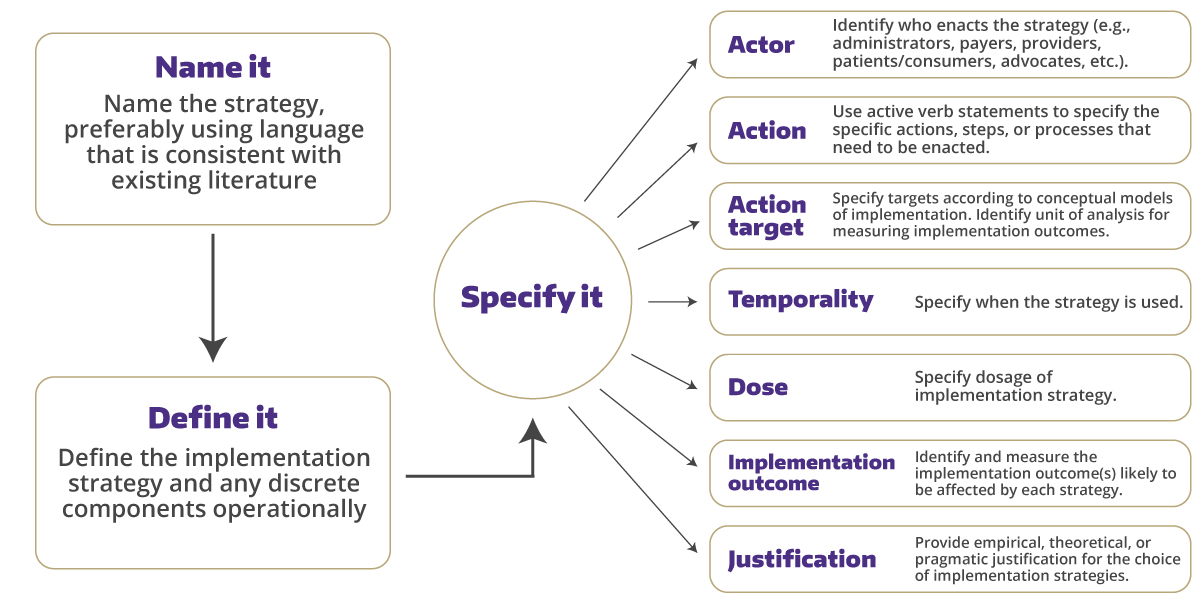
Adapted from Proctor EK, Powell BJ, McMillen JC. Implementation strategies: Recommendations for specifying and reporting. Implement Sci. 2013;8(139).
Researchers aim to identify the processes or events that drive these outcomes, often referred to as mechanisms of change. This involves developing causal models that link strategies to their effects, considering various factors such as context, barriers, and facilitators. To achieve this, researchers can use a combination of qualitative and quantitative methods to explore and validate these mechanisms.
One of the tools used to understand mechanisms of change are detailed causal pathway diagrams that map out the relationships between strategies and outcomes, including any moderators or preconditions that might influence these relationships. CPDs typically include elements such as implementation strategies, intermediate outcomes, moderators, and final outcomes, providing a clear and structured way to hypothesize and test how and why certain strategies work.
By illuminating these causal pathways, implementation scientists can provide more precise guidance on which strategies are most effective in different contexts. This helps practitioners select and tailor strategies to address specific implementation challenges, ultimately improving the delivery and impact of evidence-based practices. You can learn more about causal pathway diagramming in implementation science at ImpSciMethods.org.
Visualizing Implementation Strategy Mechanisms
The study of causal mechanisms in implementation science focuses on understanding how and why specific strategies lead to desired outcomes when implementing evidence-based practices.
In addition to causal pathway diagrams, several other methods are used to understand mechanisms of change in implementation science:
Logic Models: These are systematic and visual representations of the relationships between resources, activities, outputs, and outcomes. Logic models help in planning, implementing, and evaluating programs by clearly outlining the steps needed to achieve desired outcomes.
Implementation Mapping: This method involves a series of steps to identify and select appropriate implementation strategies. It includes conducting a needs assessment, defining outcomes and performance objectives, choosing theoretical methods, and developing implementation protocols. Implementation mapping ensures that strategies are tailored to the specific context and needs of the target population.
Mechanism Mapping: This approach focuses on identifying and understanding the specific mechanisms through which implementation strategies achieve their effects. It involves linking strategies to their mechanisms of action and evaluating these linkages through empirical research. Mechanism mapping helps in refining and optimizing implementation strategies for better effectiveness (see Kilbourne et al, 2023 for example).
Agile Science: This involves iterative testing and refinement of implementation strategies using rapid-cycle evaluation methods. Agile science emphasizes flexibility and adaptability, allowing researchers to quickly test hypotheses about mechanisms of change and adjust strategies based on real-time data.
These methods collectively enhance the precision and effectiveness of implementation strategies by providing a deeper understanding of the underlying mechanisms of change. By using these tools, implementation scientists can develop more targeted and context-specific strategies, ultimately improving the adoption and sustainability of evidence-based practices. For tools to create CPDs and to learn more about implementation mechanisms, visit ImpSciMethods.org.
If [implementation strategies] are to be scientifically tested, communicated clearly in the literature, and accurately employed in actual healthcare practice, they must be specified both conceptually and operationally.
Videos from our friends
How to Really Use Implementation Strategies, with Dr. Shari Rogal (University of Pittsburgh DISC)
Implementation Science Strategies, with Dr. Debbie Passey (University of Melbourne Centre for Digital Transformation of Health)
EQUITY CHECK: Pause and reflect
Does the proposed implementation strategy (or strategies):
❯ address barriers experienced by populations who face the greatest obstacles to access and participation?
❯ reduce rather than increase implementation burdens on under-resourced organizations, providers, or communities?
❯ provide flexibility for local adaptation while preserving core functions?
❯ support meaningful engagement and shared decision-making with affected communities?
❯ account for differences in organizational capacity, staffing, funding, infrastructure, and technology access?
❯ consider whether some groups may benefit more than others and include plans to address those disparities?
- ✪ A systematic review of experimentally tested implementation strategies across health and human service settings: evidence from 2010-2022, (Implementation Science, 2024)
- Using implementation strategies in community settings: an introduction to the Expert Recommendations for Implementing Change (ERIC) compilation and future directions (Translational Behavioral Medicine, 2022)
- ✪ A streamlined approach to classifying and tailoring implementation strategies: recommendations to speed the translation of research to practice (Implementation Science Communications, 2024)
- ✪ What is the extent and quality of documentation and reporting of fidelity to implementation strategies: a scoping review (Implementation Science, 2015)
- ✪ Beyond “implementation strategies”: classifying the full range of strategies used in implementation science and practice (Implementation Science, 2017)
- Methods to Improve the Selection and Tailoring of Implementation Strategies (The Journal of Behavioral Health Services & Research, 2017)
- Assessing Implementation Strategy Reporting in the Mental Health Literature: A Narrative Review (Administration and Policy in Mental Health and Mental Health Services Research, 2019)
- A Compilation of Strategies for Implementing Clinical Innovations in Health and Mental Health (Medical Care Research and Review, 2012)
- ✪ Use of concept mapping to characterize relationships among implementation strategies and assess their feasibility and importance: results from the Expert Recommendations for Implementing Change (ERIC) study (Implementation Science, 2015)
- ✪ Choosing implementation strategies to address contextual barriers: diversity in recommendations and future directions (Implementation Science, 2019)
- Adapting a Compilation of Implementation Strategies to Advance School-Based Implementation Research and Practice (Prevention Science, 2019)
- 🎧 That Implementation Science Podcast: Sailing the Seas of Implementation Mechanisms, with Guest Cara C. Lewis, PhD
- Precision Implementation: An Approach to Mechanism Testing in Implementation Research (Administration and Policy in Mental Health and Mental Health Services Research, 2022)